
Insights
Longer points of view from OVERWRLD on compression, capacity, and what the bytes are worth. The public benchmark is the rank. The portable binary is the product.
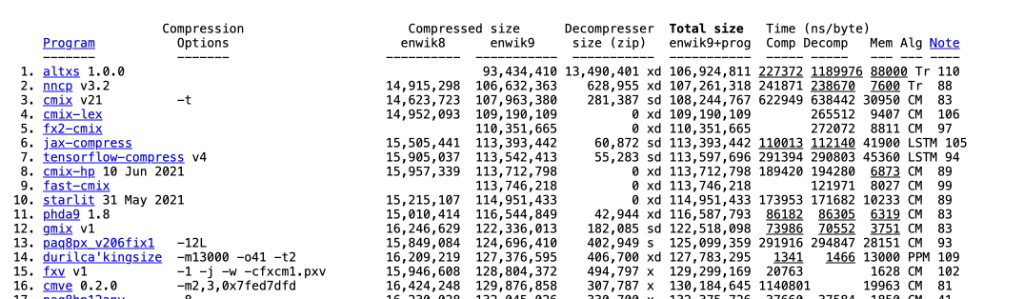
altxs 1.0.0 reaches #1 on the Large Text Compression Benchmark
OVERWRLD's lossless compressor tops Matt Mahoney's public ranking by official total size, with payload and decompressor both counted.

Precision is the gate
A cascade of specialists fails when the stage that decides what needs work invents work. High recall with ~33% precision is not capacity — joint training toward ~90% precision is the bar.

Reconstruction is not credit
Average bits-per-byte can fall in clean chunks while training quality still wobbles across passes — and reconstruction-loss shortcuts still owe a proof that they preserve real credit assignment.

Leave the hole
When a causal predictor hits positions it cannot own, forcing it to speak anyway costs more than silence. Capacity comes from leaving deliberate gaps and routing those blanks to a specialist that can see both sides.

The hard bits need both sides
Causal prediction owns the easy structure. The leftover high-cost positions are a different job — one that pays when a second objective can look both ways and a router knows which voice to trust.

When prediction saturates
Cross-entropy gets most of the way. Past that point, capacity comes from exact, cheap operators on the residual high-entropy positions — not from another layer on the same objective.

Compression is capacity
Capacity is how much work a given store, link, and watt can support. A lossless compressor that counts its decompressor, and decodes cheaply enough to ship, adds capacity without adding plant.